Olympic Iconography – Tommie Smith and John Carlos at the 1968 Mexico City Olympics.
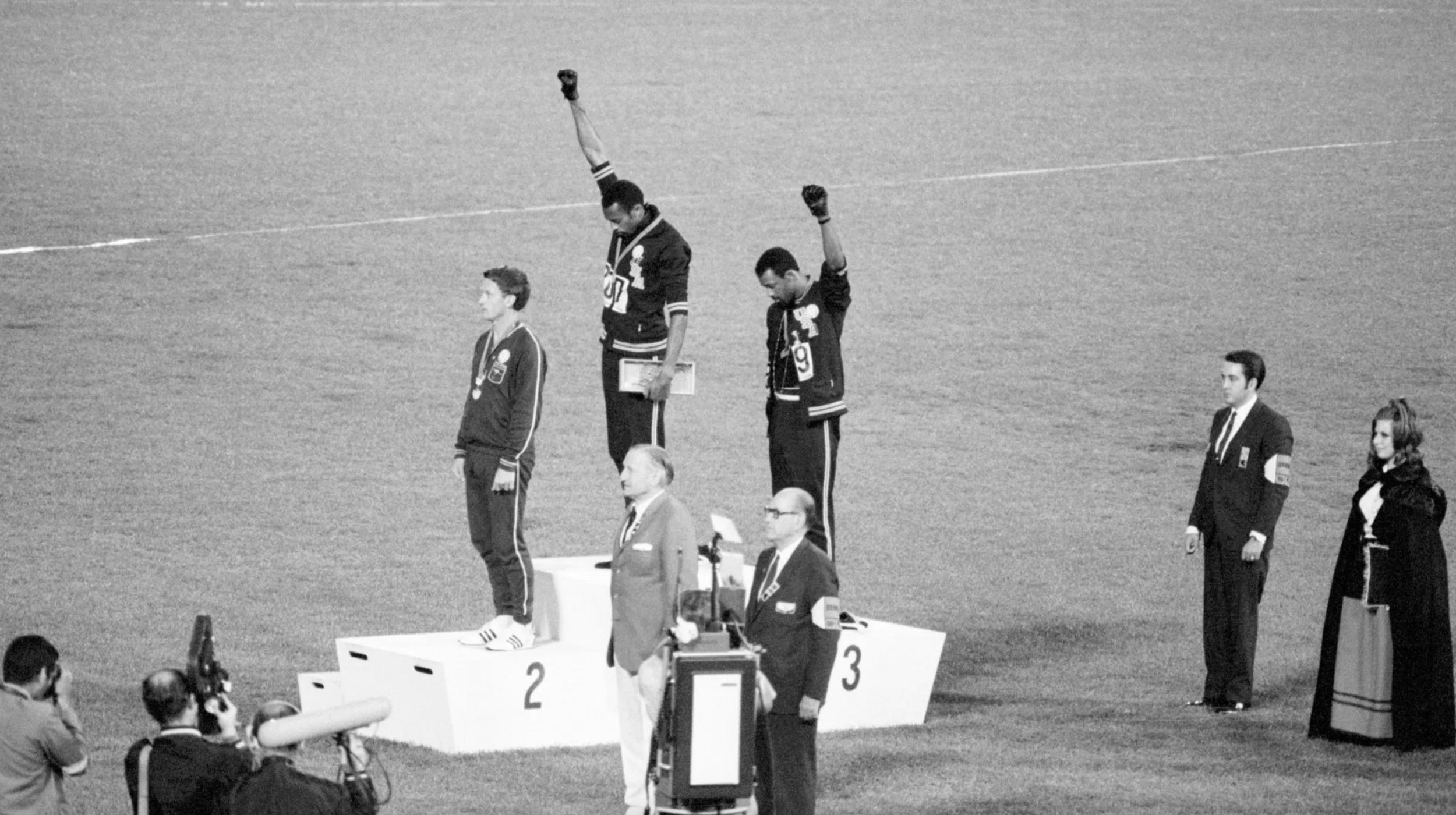
What does it mean to “use one’s platform”? While the phrase often evokes images of performative gestures on social media, track & field athletes Tommie Smith and John Carlos enacted a more literal interpretation at the 1968 Mexico City Olympics.
Standing atop the podium as gold and bronze medalists in the 200-meter dash, Smith and Carlos took off their shoes and donned beads, scarves, and one black glove – each detail a deliberate symbol of Black struggle and resistance. All three medalists, including Australian silver medalist Peter Norman, wore pins in support of the Olympic Projects for Human Rights, an organization of athletes that had formed to advocate for civil rights during the Olympic games. As the American national anthem began to play, Smith and Carlos raised their gloved fists to the sky.
For years, the U.S. had showcased Black athletes like Cassius Clay (Muhammad Ali) and Wilma Rudolph as emblems of racial progress, employing their image to export a polished vision of American virtue. But to Smith, Carlos, and the OPHR, this image-making was itself a kind of erasure: a way to obscure state violence and systemic racism behind a veneer of celebrity. Their gesture ruptured America’s self-mythologizing on the world stage, inviting attention to the truths their visibility was meant to obscure.
The consequences for Smith and Carlos were swift: expulsion from the Games, death threats, vilification in both media and the sporting world. While the spectacle of their athletic success was celebrated, their refusal to play the role assigned to them in America’s performance of progress was not (see the blacklisting of silent protestor Colin Kaepernick as evidence of this censorship's longevity).
Today, the image circulates widely, even repackaged by the Olympics as a notable fashion moment in Games history to signal the sporting event’s role in facilitating the march of progress. Even in its afterlife, the photo continues its double work of attention, reminding us not only of celebrity’s power to disrupt dominant narratives, but also of the institutional reabsorption that occurs seeking to turn such ruptures into safer, more palatable myths. That the image is now used to represent an America that would not – and did not – tolerate what Smith and Carlos actually did reveals the depth of institutional resistance to truth-telling, and the persistent power of the spotlight to either distort or illuminate what we see.