Tomato, Xitomatl
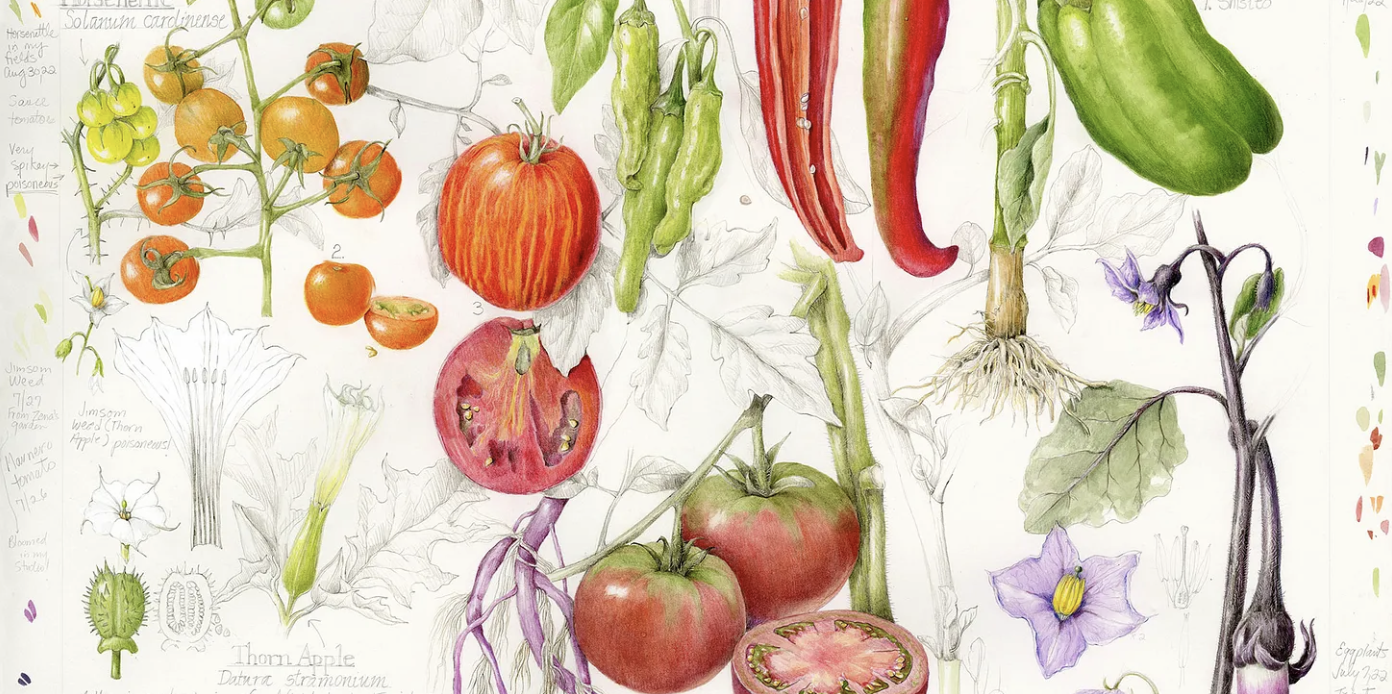
Today’s more than 10,000 tomato varieties can be traced back to the single Solanum lycopersicum, which was first found growing wild in the Andes roughly 80,000 years ago. The tomato’s millenia-long journey up the coast – through modern-day Ecuador, northern Chile, and the Galápagos – remains a mystery. The fruit’s first recorded name, however, is known to us: xitomatl, given by the Nahua people, among its most enthusiastic early cultivators.
In 1521, after the Spanish invasion destroyed the Aztec capital of Tenochtitlan, the tomato was pulled into the crosscurrents of colonial conquest/subjugation, eventually landing in the Caribbean and Europe. To the people of Europe, its arrival sparked curiosity, then concern: only the wealthy could afford this transplanted delicacy, and had the awkward side effect of making them ill. For over a century, the tomato fell into its new continental category of “poison” until an explanation emerged: the wealthy’s delicate dishware — pewter plates rich in lead — were secreting the toxic metal in the presence of the tomato’s vibrant acidity. Another theory, perhaps less engrossing, traced the tomatoes’ resemblance to the poisonous belladonna plant.
Today, the tomato is everywhere – central to countless cuisines, chopped, sauced, and sung over. It has voyaged across physical and psychological landscapes, been shaped and relocated by oppressive forces, and subjected to scientific and societal imagination and (re)interpretation. And yet, as with many trajectories measured by particular strains of modernity, the tomato remains framed in terms of its human uses. What might the tomato say of its passage through time and space, if we were to change what guides our gaze?